
When you make the decision to move forward with divorce in Philadelphia, the next step is working with a qualified family law attorney who can guide you through each phase of the process. Pennsylvania’s divorce system has defined legal steps, procedural deadlines, and strategic decisions, and an experienced attorney helps protect your rights while keeping the process as clear and efficient as possible.
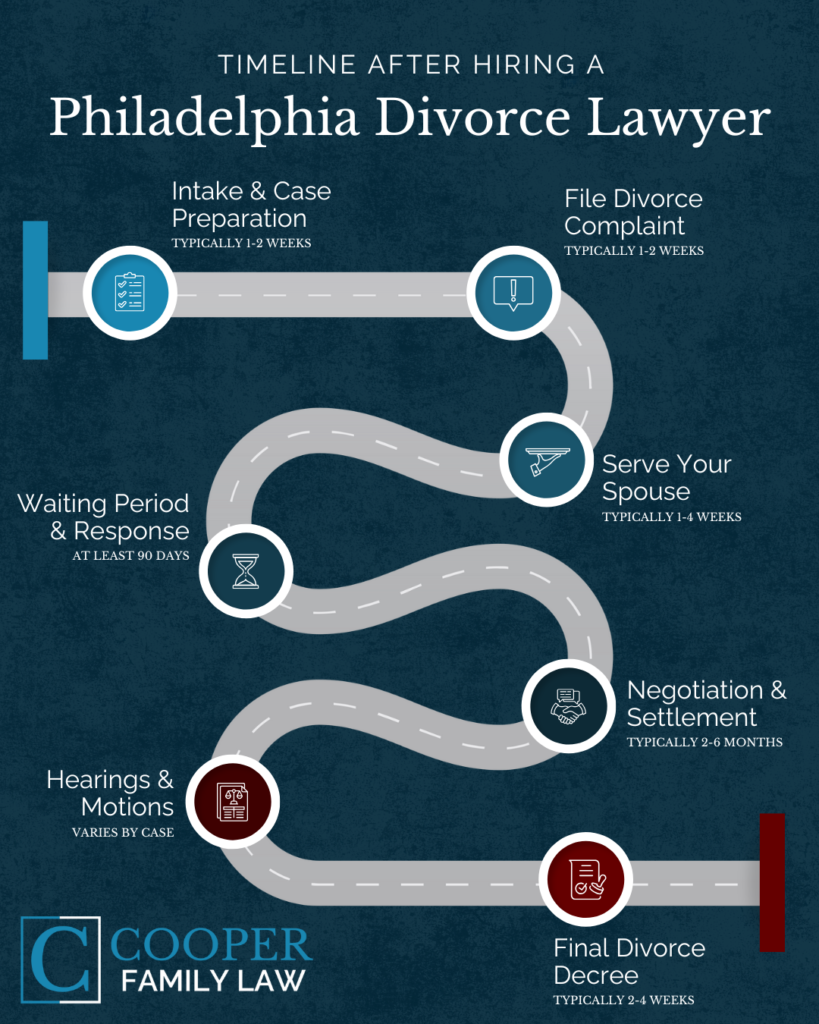
Below is a practical timeline of what typically happens after you retain counsel, with insights on how the law shapes each stage in Philadelphia and the surrounding Pennsylvania counties.
Step 1 — Intake, Strategy & Case Preparation
Once retained, your attorney will collect detailed information about your marriage, finances, children, assets, debts, and goals. Expect to:
- Complete a formal intake questionnaire
- Provide important financial documents such as tax returns, pay statements, bank & investment statements
- Discuss custody preferences, support needs, and marital property concerns
Your lawyer needs a complete picture to determine the best approach, whether pursuing a mutual consent divorce, negotiating settlement terms, or preparing for litigation if the case is contested.
Step 2 — Filing the Divorce Complaint
Your attorney will prepare and file a Divorce Complaint with the Court of Common Pleas in the county where you or your spouse lives (Philadelphia, Bucks, Montgomery, Delaware, or Chester County). Pennsylvania’s divorce law allows either party to seek a divorce on no-fault or fault grounds, though almost all modern cases use no-fault bases such as mutual consent or irretrievable breakdown.
Your lawyer drafts and files the complaint and other required forms, ensures all documents comply with Pa.R.C.P. procedural requirements (see Pa.R.C.P. 1920.42 for divorce decrees), and coordinates filing logistics with the prothonotary (clerk) at the courthouse.
Step 3 — Serving Your Spouse with Legal Notice
After filing, your attorney must ensure service of the divorce complaint on your spouse. Pennsylvania law requires proper notice, typically personal service via a process server or sheriff, or acceptance of service. This preserves due process and avoids delays.
If you do not know where your spouse is, it can cause difficulties and delays in the divorce process.
If service is not able to be completed promptly, your attorney may need to reinstate documents or seek court approval for alternate methods of service to continue the case.
Step 4 — Mandatory Waiting Period & Response
Under Pennsylvania law, for a no-fault mutual consent divorce, the court requires a minimum 90-day waiting period after service before a decree can be entered, provided that both spouses file affidavits of consent (must be filed at least 90 days after the divorce complaint is served and within 30 days of being signed) stating that the marriage is irretrievably broken.
For parties who agree that they have been separated for over one year, Pennsylvania law allows the process to be completed more quickly. The divorce complaint must still be filed and served on the defendant, but the waiting period is reduced to 40 days, with an even shorter 20 days if both parties sign and file waivers of notice of intention. It is important to note that these waiting periods are only with respect to when your attorney can file the final request with the court for issuance of a divorce decree, not when the court will actually issue a divorce decree. It is also important to note that all financial issues related to the divorce must be resolved prior to the court granting your divorce decree. This process can take a long time and is further discussed below.
Your lawyer will advise you on the exact timing, but the waiting period begins once your spouse has been properly served. Your lawyer will also prepare or review required consent affidavits and track filing deadlines to preserve your right to proceed efficiently.
Step 5 — Discovery, Negotiation & Settlement
Most Pennsylvania divorces requiring asset division involve the evaluation of the marital estate (assets and debts) and settlement negotiations before any hearing. Your attorney will help you:
- Exchange financial information with your spouse through “discovery”
- Identify marital vs. separate property
- Value the marital assets and debts
- Discuss the equitable distribution of assets and debts
- Address custody, parenting time, child support, and spousal support
In many cases, divorcing couples can reach a Marital Settlement Agreement or Property Settlement Agreement that resolves these topics without trial, a route that saves time and reduces stress.
Negotiation strategy is not one-size-fits-all; it must reflect Pennsylvania’s equitable distribution rules and local court practices. In some cases, there are contested issues of law or fact. Some individuals and/or their attorneys will not negotiate reasonably in good faith. In those matters, a court hearing will likely be required.
Step 6 — Court Filings & Possible Hearings
If you and your spouse agree on all major issues, your attorney may prepare an agreement to submit to the court, sometimes without a formal hearing.
If issues remain contested, your attorney can file motions, present testimony, and advocate for you at hearings on issues such as custody disputes, support amounts, or interim relief.
The attorney’s role here includes:
- Draft briefs or memoranda supporting your legal positions
- Prepare you to testify if needed
- Represent you in front of the judge
Step 7 — Entry of Divorce Decree
Once all legal requirements are met, including the waiting period, proofs of service, consent affidavits, and resolution of ancillary financial issues, your attorney will submit a Praecipe to Transmit Record or proposed decree to the court. When the judge signs the decree, your divorce becomes final.
Before entry, your lawyer will check for proper completion of affidavits and forms, resolution or agreement on ancillary claims (property, support), and compliance with procedural rules under Pa.R.C.P. and state law.
After the Divorce — Orders & Compliance
Once the divorce is final, representation may continue for:
- Modifications — child support or custody changes if life circumstances change
- Enforcement — ensuring the other party follows the decree’s terms
- Post-decree disputes — property settlement enforcement, relocation issues, or support adjustments
This ongoing guidance protects your interests long after the divorce decree is entered.
Why Having a Philadelphia Divorce Lawyer Matters
Pennsylvania’s divorce statutes and court procedures are technical, and missing even one filing requirement can delay or jeopardize your case.
A skilled Philadelphia divorce attorney ensures:
- Compliance with legal requirements
- Strategic negotiation and advocacy
- Clear communication at every step
- Protection of your rights and future financial stability
Thinking About Next Steps?
If you’ve already decided to pursue divorce in Philadelphia, scheduling a consultation with a family law attorney ensures your case gets started on the right foot. Each divorce is unique, but with the right legal support, you can move forward with confidence and clarity.