Divorce in Pennsylvania does not follow a single path. Each case is shaped by the relationship between the spouses, financial circumstances, and the family’s needs. Some divorces are resolved quickly through agreement, while others require litigation to address disputes.
At Cooper Family Law, our attorneys assist clients in Philadelphia and throughout Delaware, Montgomery, Bucks, and Chester Counties in understanding their options under Pennsylvania law and in choosing the legal process that best protects their future.
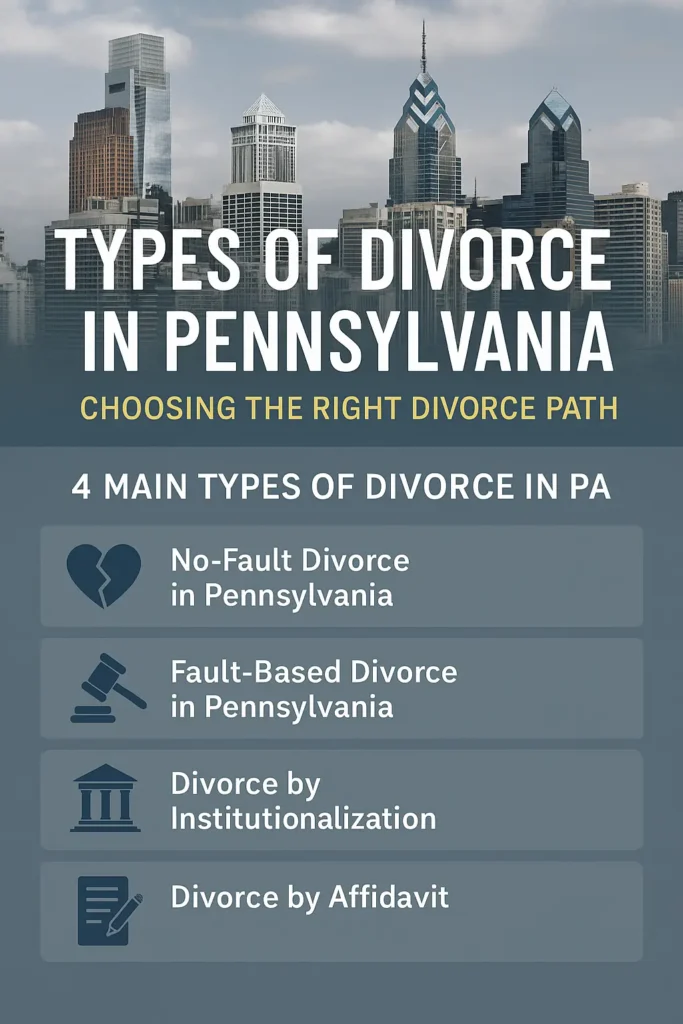
4 Main Types of Divorce in PA
1. No-Fault Divorce in Pennsylvania
Pennsylvania recognizes divorce under no-fault grounds, meaning you do not need to prove wrongdoing by your spouse to obtain a divorce. Instead, you must show that the marriage has reached an irretrievable breakdown.
Mutual Consent Divorce Mutual consent requires:
Both parties agree that the marriage is irretrievably broken.
Each signs an affidavit stating consent.
After a 90-day waiting period from when the divorce complaint is filed and served, the court may issue a final divorce decree.
Benefits: This process is often quicker, less costly, and promotes cooperation, especially in uncontested divorce cases.
Unilateral No-Fault Divorce (One-Year Separation)
One spouse files for divorce, even if the other spouse disagrees.
Divorce can proceed once the parties involved have been living separately for at least one year.
Best For: Cases where only one spouse wants the divorce or refuses to sign consent forms.
2. Fault-Based Divorce in Pennsylvania
Though less common today, a fault-based divorce may be pursued when the filing spouse can provegrounds for divorce, such as:
Adultery
Desertion for one year or more
Cruel treatment or cruel and barbarous treatment
Bigamy
Incarceration for two or more years
Indignities (behavior making life intolerable)
Why choose a fault divorce?
Fault grounds may affect alimony payments or financial outcomes.
It may be necessary when the other spouse refuses to consent and there is strong evidence of misconduct.
Considerations: Proving a spouse’s fault often requires presenting evidence in court, which can increase legal fees, stress, and the duration of the divorce proceedings.
3. Divorce by Institutionalization
Pennsylvania divorce law also allows a divorce if one spouse has been confined to a mental institution for at least 18 months due to a serious mental disorder, with little likelihood of discharge in the following 18 months. This process requires medical documentation and court approval.
4. Divorce by Affidavit
In certain uncontested divorce cases, spouses may submit affidavits of consent without attending court hearings. This option is often used after the 90-day waiting period when all terms of custody, support, and property division have already been resolved.
Key Issues in Pennsylvania Divorce Cases
Marital Property and Equitable Division
Under Pennsylvania divorce laws, marital property includes most property acquired during the marriage, such as real estate, retirement accounts, bank accounts, and debts.
Courts apply the principle of equitable division, which meansproperty is divided fairly but not necessarily equally. Factors Pennsylvania courts consider include:
Length of the marriage
Each spouse’s earning capacity
Contributions to marital assets and household
Marital misconduct or fault grounds
Spousal Support and Alimony
Financial support obligations may arise during and after the divorce process.
Spousal support may be ordered during separation.
Alimony payments may be awarded after the final divorce decree to help the lower-earning spouse maintain stability.
Factors include income disparity, duration of marriage, marital misconduct, and the financial needs of the injured spouse.
Child Custody and Child Support
Divorce cases involving children must addresschild custody and support. Courts focus on the child’s best interests, considering:
Stability of each parent’s home
History of domestic violence or personal injury crime
Ability to provide emotional and financial support
Child support is typically calculated based on both parents’ incomes and the custody schedule.
Residency Requirements for Divorce in Pennsylvania
To initiate a divorce action, at least one spouse must have resided in Pennsylvania for at least six months before filing the divorce complaint.
The Divorce Process in Pennsylvania
Filing a divorce complaint with the court
Serving the other spouse with divorce papers
Waiting periods or separation requirements, depending on divorce type
Negotiation or litigation of issues such as property division, support, and custody
Entry of the final decree, which legally ends the marriage
How Cooper Family Law Can Help
Every divorce case is unique. Whether your situation involves a mutual consent divorce, a contested property division, or allegations of marital misconduct, having trusted counsel is essential.
At Cooper Family Law, we bring over 50 years of combined experience guiding families in Philadelphia and across Southeastern Pennsylvania through divorce proceedings with clarity and compassion. Our attorneys safeguard your financial interests, prioritize your children’s well-being, and ensure you move forward with confidence.
Family Matters. Experience Counts. Contact us today to schedule a confidential consultation and take the first step toward resolution.
Philly Favorites: Gold Winner (Best Family Law, Best Estate Law) 2026
Avvo Client's Choice - Zachary S. Bartman 2026
Super Lawyers: Patrick J. Cooper 2023 - 2026
Avvo Rating: 8.9 - Zachary S. Bartman
National Academy of Family Law Attorneys: Top Ten 2024
Rising Stars: Zachary S. Bartman 2023 - 2026
TrustAnalytica: Top 10 Philadelphia Divorce Attorney 2026
Avvo: 9.7 Rating - Patrick J. Cooper
Rising Stars: Sarah Tarczewski 2026
Better Business Bureau: A Rating Cooper Family Law
Attorney At Law Magazine: Local Legal Authority
ThreeBestRated: Philadelphia Divorce Lawyers
Expertise.com: Best Philadelphia Divorce Lawyers
Justia: 10 Rating - Patrick J. Cooper
Martindale-Hubbell: Client Champion
Elite Lawyer: Divorce & Separation - Patrick J. Cooper 2025
Philly Favorites: Gold Winner (Best Divorce Law, Best Law Firm & Best Estate Law) 2025
Philly Favorites: Bronze Winner (Best Family Law) 2025
Attorney and Practice Magazine: Family Law 2024
Philly Favorites: Silver Winner (Best Family Law) 2024
Avvo Client's Choice - Zachary S. Bartman 2024
America's Best Advocates: Family Law 2023
Let Cooper Family Law Help You Navigate Divorce
Divorce is never easy, but understanding your legal options can make the process more manageable. Whether you and your spouse are on the same page or far apart, Cooper Family Law is here to help you make informed decisions and move forward with confidence.
Contact us today to discuss your situation and determine which type of divorce best suits your needs.
The best way to understand how Cooper Family Law can support you is by hearing directly from those we’ve helped. Our clients consistently praise our attentive service, thoughtful legal guidance, and successful outcomes. Read through our client testimonials to see why families across the Philadelphia region trust us with their most important legal matters.
5 stars isn't enough to recognize Zach Bartman's dedication, work ethic and thoroughness. Right from the first consult when we very bluntly/honestly indicated the approach we were looking to take to have as permanent of a legal ruling as is possible in an overstretched Philadelphia Family Court, Zach responded with clear strategy approaches and answered every question with patience and kindness. What really speaks to his expertise is that it took a mere TWO very effective court dates to… More achieve results deeply important to our family's well-being that no former counsel even bothered fighting for. Zach is worth his experience, kindness and legal approach to family law matters if you're considering moving forward with him as your attorney. He's able to be pragmatic and solutions-focused with humour. I can't speak highly enough of him.
Carol Krawitz Verlin of Cooper Family Law handled my case with the utmost care. She was very thorough and her proposal was accepted immediately without question or hesitation by the opposing party. After pouring through several years of court documentation, she was able to close the case in an expeditious manner. I would utilize the services of Cooper Family Law again.
Cooper family law took care of me so well through all of my legal issues. From complex situation and context building about my individual scenario, to a favorable outcome and fair agreement. I couldn’t recommend them enough. While all the attorneys at their firm are fantastic, Sarah T handled my case with care and attention to detail unmatched by anyone else!!!
Although Patrick was ultimately unable to take my case due to prior contact from the other party, he still took the time to speak with me and explain the situation with clarity and professionalism. I appreciated his honesty and integrity, as well as the thoughtful guidance he offered during a difficult moment. It’s rare to encounter someone so straightforward and respectful, and I would not hesitate to recommend him to anyone seeking knowledgeable and ethical legal counsel.
First I will like to thank you Carol for always responding to my emails and calls when whenever I call your office. You made my custody hearing so easy for me. You make me feel comfortable in the waiting room,You were asking me if I have any questions for you.Thanks to you I got sole legal and sole physical of my two kids and I’m so grateful for this. My mom and I appreciate you for everything
My divorce was a long and grueling process. I was very lucky to have somebody like Pat in my corner. Many times he went above and beyond my expectations and helped me through a really difficult time.Pat was readily available for whenever I needed him, which wound up being often. He is a stand-up guy who is knowledgable and experienced. He was ready to go to bat for me at a moments notice when the situation arrived (which wound up being often).Getting divorced is overwhelming, scary, and can make… More you feel like you are on your own. Having a guy like Pat on your side makes it a little bit easier.I highly recommend Pat.
I am very grateful to have found Patrick and Monique in a difficult time! They were patient, reliable, always available to answer questions and provide recommendations along the way. I felt my interests were important to them and represented at every juncture. The process was smooth and handled so professionally, I never doubted I had experts in my corner.I’d absolutely recommend Cooper Family Law to anyone seeking legal representation!
I am grateful to have Patrick Cooper as my family lawyer. Patrick Cooper and his team was the highly competent, engaging, and accessible legal professionals that I needed to guide me through very complex legal matters that I was unfamiliar with. Attorney Cooper is not only well-informed, but also easy to talk to, takes the time needed to interpret the law and advise on options, cares about outcomes, and is affordable. I highly recommend the Cooper Family Law firm without any hesitation.
I am beyond grateful for the exceptional representation I received from attorney Zachary throughout my long and challenging custody case. This process has taken years prior to Cooper Law Firm and has been incredibly difficult—emotionally, mentally, and physically—for both me and my son. From the very beginning, Zach approached my case with compassion, professionalism, and an unwavering commitment to achieving what was best for my child’s wellbeing.As a young mother, I often felt dismissed or misunderstood… More before finding Cooper Law Firm. He was the first attorney who truly listened, believed in me, and validated what I was experiencing. He never made me feel irrational or unheard. Instead, he helped me feel grounded and supported through every step of the process.Zach’s dedication, attention to detail, and genuine care for my son’s mental and physical health were evident in everything he did. He consistently fought for what was right and made sure my son’s best interests were always the top priority.Thanks to Zach’s expertise and persistence, my son and I finally have the stability and peace we’ve been working toward for years. I cannot recommend Zach and his firm highly enough to anyone facing a difficult custody matter. Their professionalism, empathy, and commitment truly set them apart.
Working with Cooper Family Law has been an excellent professional experience. Patrick Cooper demonstrates exceptional expertise in divorce law and maintains clear, timely communication throughout every stage of our collaboration. Their attention to detail and commitment to client outcomes make them a reliable partner in the legal field. Highly recommended for anyone seeking knowledgeable and efficient divorce attorneys in Philadelphia.
Cooper Family Law is the best divorce law firm in the Philadelphia area. They handled my complicated divorce with child custody, support, and division of property issues. My attorney and the support staff were excellent. They really took the time to understand my situation, explain the process to me, and helped me approach every decision that I had to make in an educated and practical way. I strongly recommend them to anyone else who needs a divorce lawyer in the Philadelphia area.
Zachary Bartman was an outstanding lawyer and I’m extremely grateful for his representation in my PFA case. He was professional, knowledgeable, and well-prepared from start to finish. He took the time to explain everything clearly, answered my questions honestly, fought hard for me in court and completely shut out the opposing council. Thanks to his expertise and confidence, we won the case. I highly recommend Zachary Bartman to anyone who needs a skilled and dependable attorney, especially for PFA… More matters.
My child custody case has been difficult from day one. I was previously represented by a lawyer who was not straightforward with me about the process and did not explain my options clearly. Working with the Cooper Family Law team was so much better. Like night and day. Patrick and his team were friendly and helpful from the beginning. Everyone that I worked with on the team was really sharp and also kind. They guided me through a very difficult time. They are the best child custody lawyers in the… More Philly area!
I hired the firm to draft my prenuptial agreement, including helping me put together my goals and the necessary disclosures. They were informative, efficient and personable but most importantly they kept us on track throughout the process so that we were able to finalize everything well before our wedding.
Zach is the guy that knows what he is doing. The system might appear to not be on your side at the beginning of your litigation, but Zach not only builds your case squarely but he also brings the law to your side with equity and fairness.You cannot be wrong with him. Thank you
Carol Krawitz has been nothing short of amazing. This has been the most difficult time of my life; however, Carol has made this transition for me as smooth as possible. She has displayed a great understanding of family law, which has helped me through my custody issues. Although my journey isn't over, I'm happy with the results that I have achieved with Carol Krawitz leading the process.
I had an extremely great experience with Zachary Bartman! I can’t thank him enough for the help he provided me with during an incredibly difficult time. I contacted the bar association, and he reached out to me first within that same day. He took the time to listen to me and assess the situation. Although it took time to detain him due to unfortunate events. That initial contact from him stuck with me! He led with confidence, empathy and compassion. I felt safe, heard, understood and supported all… More in a short phone call. When I was ready to start my legal journey; I called him back and he and his assistant Anna (I believe) met me with so much patience and grace. My custody and Divorce matter was a challenging situation, but he made it manageable and provided me with a phenomenal level of professionalism and understanding that made me feel ready, empowered and reassured. I was overwhelmed emotionally, and I have been bullied for years and tried to avoid the courts. I needed counsel at this point; I wanted fairness and what was best for my children. He walked me through the entire process before it happened; we talked, I cried, he listened to my story sincerely, we laughed at my thoughts/ jokes lol I felt supported the entire way! He made me proud the way he stepped up and handled the room. I will highly recommend Mr. Bartman to anyone in need of one of the best Divorce & custody lawyers! Cooper Family Law, you have a gem! Thank you!
Zachary helped me through my case. I truly believe it was because of him that I won. He listened to my story and he made sure the truth was heard in trial. He fostered confidence in me during a very anxious time. He was professional, polite, and understood his job very well. He walked me through the entire process before it happened and provided reassurance throughout. I'd recommend him to anyone I know.
I can’t thank Pat and his staff enough for the help they provided my family during an incredibly trying time. He took the time to listen and assess the situation, make thoughtful recommendations, and be a constant resource so we achieved our goal of a fair and equitable outcome. One of the best in PA!
Never a pleasure to be in court, but always a pleasure to work with Cooper Family Law. From the very beginning, they made a challenging situation manageable and provided a level of professionalism and understanding that was both reassuring and empowering. The team is thorough, responsive, and incredibly knowledgeable about family law, guiding me through each step with patience and clear communication. Zachary Bartman, in particular, was a standout—his dedication and expertise led to a favorable outcome… More in my case, and I felt supported the entire way. If you're looking for a firm that truly has your back, Cooper Family Law is the one.
It was a smooth experience with this lawyer. She was very nice and polite. She did everything to make the divorce easy and smooth so I will appreciate anybody that want to use her in divorce to go ahead and have that confidence in this lawyer OK thank you guys. God bless.
Pat is a highly knowledgeable and compassionate family law attorney. Handles cases with professionalism and care, ensuring the best outcomes for his clients. Highly recommend!
Pat Cooper has the experience, expertise and communication skills that deliver favorable results. Pat's familiarity with Philadelphia's courts and judges proved invaluable.
Mr. Cooper’s “bedside manner” - if you will - is almost avuncular. His mastery of jurisprudence is evident after mere minutes into a conversation.To be succinct: The man is good at what he does.
I recently had the pleasure of working with Cooper Family Law, particularly with Zachary S. Bartman, for the preparation of a prenuptial agreement. From the initial consultation to the finalization of the prenuptial agreement, Zachary S. Bartman demonstrated a high level of professionalism, expertise, and dedication. He meticulously explained every aspect of the agreement, ensuring that I understood all the terms and conditions involved and that the agreement was fair and comprehensive. His responsiveness… More was remarkable—he consistently replied to my inquiries in a timely fashion, which greatly contributed to the smooth and efficient process.The entire process with Cooper Family Law was seamless, thanks to Zachary’s diligent efforts. The firm’s organizational skills, combined with Zachary’s expertise, made what could have been a stressful and complicated procedure remarkably straightforward and stress-free.I highly recommend Cooper Family Law and Zachary S. Bartman to anyone in need of legal assistance with prenuptial agreements or any other family law matters.
I was given last minute notice that I had to appear in court for a legal matter. I had one day to find representation and when I called Cooper Family Law, they took the time to listen to me and responded swiftly. Mr. Zachary Bartman contacted me to discuss the case and assured me that he would meet me in court the following day. Mr. Bartman exceeded my expectations in every way when it came to handling my case. He addressed any questions or concerns that I may have had. While I hated having to be… More in court, Mr. Bartman helped to make it more bearable for me. I can’t say enough good things about Mr. Bartman and this firm. In the end we got the desired outcome and I don’t believe it would have been possible without him. I am extremely appreciative for your help throughout this process, Zachary. I would 100 percent recommend this firm and if the need arises in the future, I will have them represent me. If you find yourself reading my review, please understand that I hate leaving reviews so that should speak to the level of professionalism that Zachary displayed. Don’t hesitate to contact Cooper Family Law if you need assistance.
Zach did a excellent job in handling my pfa case. Zach is very intelligent and sharp as a tac in handling the false accusations made against me. Most importantly you should consider hiring him to help you defend against a pfa because when it's time for him to do his job, he takes control of the court room and gets it done. It doesn't matter what kind of lies you are up against and the new lies that come out during court Zach puts it down thank you for the awesome job. Robert Nimchuk
When I first realized I needed a lawyer for my custody situation, I simply googled custody law and chose to call Cooper Family Law because I had heard the name before through some advertisement somewhere. My consultation with Zachary Bartman was smooth and reassuring but when I met him in person I noticed he looked super young, and I feared he lacked the experience needed to produce my desired outcome.My ex refused to concede any ground at all, and we were forced to go to a custody trial. When I… More tell you Zachary Bartman completely overwhelmed opposing counsel and made their arguments appear foolish to our trial judge, I am not exaggerating. In fact, I felt foolish for judging a book by its cover. He was able to get me what my family and I had set out for despite a mountain of lies and nonsense impeding us. I now cherish the time I get to spend with my son, and I thank God I picked up the phone to call Cooper Family Law everyday. I will highly recommend Mr. Bartman to anyone in need of one of the best custody lawyers in Philly/Delco/Montco areas, and if I am ever in another pickle I know he’s the guy to get the job done.



 Arshiya
★★★★★
Arshiya
★★★★★
 William
★★★★★
William
★★★★★
 Andrew
★★★★★
Andrew
★★★★★
 Marine
★★★★★
Marine
★★★★★
 Zainab
★★★★★
Zainab
★★★★★
 Michael
★★★★★
Michael
★★★★★
 K
★★★★★
K
★★★★★
 Jeffrey
★★★★★
Jeffrey
★★★★★
 Gladys
★★★★★
Gladys
★★★★★
 Mark
★★★★★
Mark
★★★★★
 Saira
★★★★★
Saira
★★★★★
 Hans
★★★★★
Hans
★★★★★
 Travis
★★★★★
Travis
★★★★★
 Gansu
★★★★★
Gansu
★★★★★
 Stanley
★★★★★
Stanley
★★★★★
 Anthony
★★★★★
Anthony
★★★★★
 Latia
★★★★★
Latia
★★★★★
 Marc
★★★★★
Marc
★★★★★
 Douglas
★★★★★
Douglas
★★★★★
 Jian
★★★★★
Jian
★★★★★
 Ernest
★★★★★
Ernest
★★★★★
 Mark
★★★★★
Mark
★★★★★
 Richard
★★★★★
Richard
★★★★★
 Ian
★★★★★
Ian
★★★★★
 Yulia
★★★★★
Yulia
★★★★★
 Anish
★★★★★
Anish
★★★★★
 Daril
★★★★★
Daril
★★★★★
 robert
★★★★★
robert
★★★★★
 Richard
★★★★★
Richard
★★★★★
 Sahirah
★★★★★
Sahirah
★★★★★