
When facing divorce in Philadelphia, one of the first questions many people ask is whether mediation or litigation will “cost less.” That question, while understandable, often oversimplifies the decision.
In reality, the more important question is which process delivers the best value for your specific case.
Mediation and litigation allocate costs differently, create distinct risks, and yield different outcomes, particularly in cases involving complex finances, custody disputes, or power imbalances.
This is where many people get it wrong. Focusing only on upfront costs can lead to more expensive, harder-to-fix decisions later.
Cost Is Not Just a Dollar Amount
In divorce, cost should be evaluated across multiple dimensions:
- Legal fees
- Time investment
- Risk exposure
- Quality and durability of the outcome
A lower upfront expense can lead to significantly higher downstream costs if issues are not properly addressed. This is especially true in Philadelphia cases, where incomplete agreements often return to court for enforcement or correction.
Mediation Costs: Where the Money Goes
In Philadelphia divorce cases, mediation costs are typically tied to:
- The mediator’s hourly rate
- Preparation time
- Attorney involvement (if parties are represented)
Mediation is often less expensive per hour than litigation, but the total cost depends heavily on how prepared the parties are and whether mediation actually resolves the core disputes.
Where Mediation Delivers Strong Value
Divorce mediation often provides excellent value when:
- Financial information is complete and reliable
- Asset valuation is not seriously disputed
- Both parties understand the marital estate
- Negotiation leverage is relatively balanced
In these situations, mediation can reduce legal fees by narrowing issues and avoiding extended court involvement.
It can be particularly effective in Philadelphia cases once both sides have exchanged sufficient financial documentation and understand the likely range of outcomes under Pennsylvania’s equitable distribution framework.
Where Mediation Can Become Costly
Mediation loses value when:
- Discovery has not occurred
- One party controls financial information
- Valuation of assets is contested
- Agreements are rushed or incomplete
When mediation fails after significant time and expense, parties often incur both mediation costs and litigation costs, without the benefit of early structure.
This is one of the most common frustrations clients experience. What begins as an effort to “save money” can turn into a longer, more expensive process when foundational issues are left unresolved.
Litigation Costs: What You’re Paying For
Litigation costs in Philadelphia divorce cases reflect a different type of investment.
Legal fees often include:
- Formal discovery under Pa.R.C.P. No. 1920.33
- Motion practice and hearings
- Expert involvement (financial, custody, valuation)
- Court conferences and trial preparation
Litigation is not inexpensive, but it provides compulsion, structure, and enforceability that mediation does not.
In many Philadelphia cases, that structure is what allows the case to move forward, particularly when financial disclosure is incomplete or disputed.
Litigation as a Value Tool, Not a Default
While litigation carries higher upfront costs, it often delivers value when:
- Assets or income are disputed or concealed
- Custody issues require judicial fact-finding
- Power imbalances undermine negotiation
- Legal precedent or enforceability matters
Pennsylvania courts apply equitable distribution under 23 Pa.C.S. § 3502, which requires accurate valuation and disclosure, something litigation is designed to enforce.
In these cases, litigation can prevent unfavorable settlements that cost far more in the long run.
The Hidden Costs Clients Often Overlook
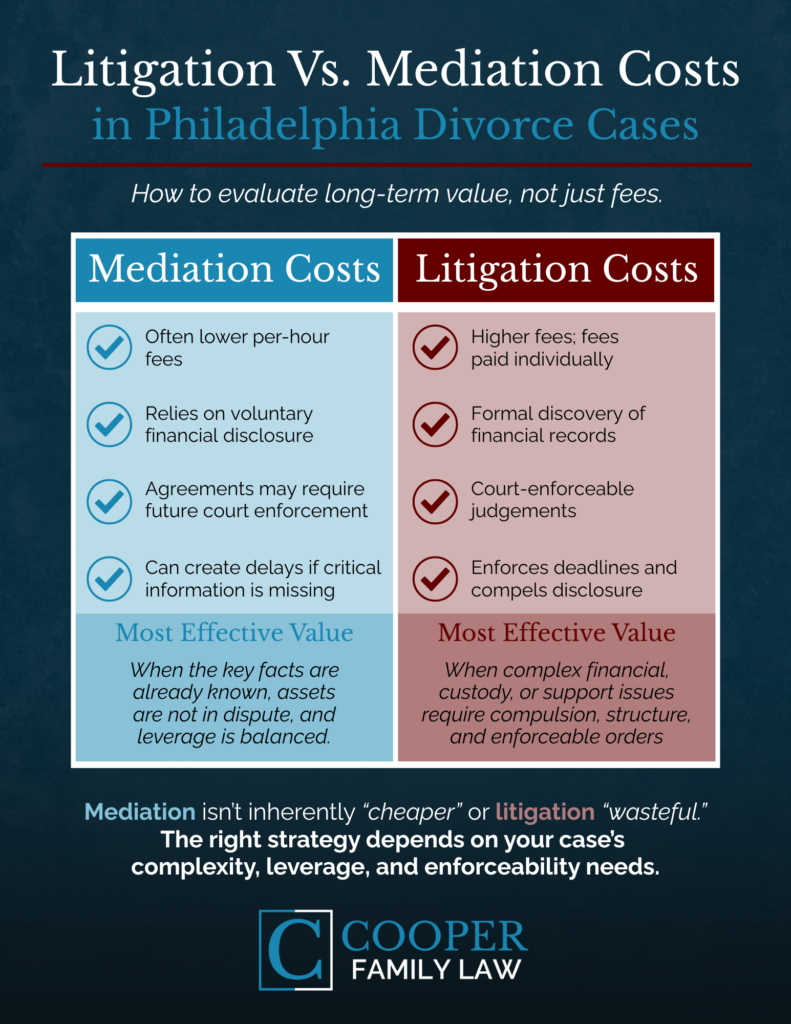
The infographic on page 3 highlights a key issue: the real cost of divorce is often not visible at the outset.
Incomplete Agreements
Agreements reached without sufficient analysis may:
- Fail to address tax consequences
- Misvalue assets
- Create enforcement disputes
Fixing these issues later often requires litigation, at additional cost.
Delay and Uncertainty
Repeated mediation sessions without progress can:
- Prolong emotional and financial strain
- Increase divorce attorney involvement indirectly
- Delay final resolution
Time itself is a cost, particularly in high-income households or cases involving shared financial obligations.
Enforcement Problems
Mediated agreements that lack clarity or structure may be difficult to enforce, leading to post-divorce litigation that can exceed any initial savings.
This is especially relevant in Philadelphia courts, where vague or incomplete agreements often require additional proceedings to clarify or enforce.
A Hybrid Approach Often Maximizes Value
In many Philadelphia divorces, the most cost-effective approach is not mediation or litigation; it’s a strategic combination of both.
Common value-driven strategies include:
- Targeted discovery followed by mediation
- Litigation for valuation, mediation for division
- Mediation on custody logistics after court-defined parameters
This approach aligns negotiation with real leverage and information, rather than assumptions.
How Judges View Cost Arguments
Philadelphia judges do not evaluate cases based on who spent less. They focus on:
- Reasonableness of positions
- Good-faith participation
- Compliance with procedural rules
Courts do not penalize parties for litigating when litigation is necessary. In fact, attempting to resolve complex issues without sufficient information can sometimes create more problems than it solves.
The Bottom Line
Mediation is not inherently “cheaper,” and litigation is not inherently “wasteful.” Each carries costs and value, depending on the case.
The real question is whether the chosen process:
- Protects your financial interests
- Produces an enforceable, durable outcome
- Matches the complexity of your divorce
Cost should be evaluated strategically, not emotionally.
Evaluating the Right Process for Your Divorce
If you are weighing mediation versus litigation in a Philadelphia divorce, a clear understanding of cost and value is essential.
At Cooper Family Law, you’ll receive practical, strategic guidance tailored to your situation, helping you determine where your time and resources are best spent, and how to move forward with confidence.
Schedule a confidential consultation to discuss your options.