
Divorce is personal. Family Court is not.
If your case reaches litigation in Philadelphia, the way you present yourself, your preparation, your credibility, and your decision-making can directly impact the outcome.
Judges are not just evaluating legal arguments. They are assessing how each party approaches the process, handles conflict, and focuses on resolution or escalation.
Understanding what judges expect doesn’t mean trying to “win” on personality. It means avoiding the common mistakes that quietly undermine otherwise valid cases.
Judges Expect You to Take the Process Seriously
Even when hearings feel informal, Family Court is not.
Philadelphia judges expect litigants to understand that:
- Divorce is a legal proceeding governed by rules and deadlines
- Court time is limited and must be used efficiently
- Orders and procedural requirements are not optional
This is where many cases start to lose ground.
Missed deadlines, incomplete filings, or a lack of preparation signal to the court that a party is not taking the process seriously, regardless of the underlying issues.
In a high-volume court like Philadelphia, those missteps don’t go unnoticed.
Credibility Matters, More Than Most People Realize
Judges evaluate credibility continuously, not just during testimony.
This includes:
- Consistency between written filings and what is said in court
- Accuracy and completeness of financial disclosures
- Conduct toward the other party throughout the case
Small inconsistencies can have a cumulative effect.
Exaggerations, omissions, or shifting positions may seem minor in the moment, but over time they can erode trust, impacting everything from settlement discussions to final decisions on financial or custody issues.
Cooperation Still Matters, Even in Contested Cases
Divorce is inherently adversarial, but that doesn’t mean resistance is always strategic.
Judges expect litigants to demonstrate reasonable cooperation, including:
- Following court orders promptly
- Participating meaningfully in required processes
- Avoiding unnecessary delays or obstruction
This does not mean agreeing to unfavorable terms. It means engaging with the process in a way that allows the case to move forward.
Courts in Philadelphia are quick to recognize when conflict is being driven unnecessarily, and that perception can influence how arguments are received.
In Custody Matters, the Focus Is Not on You
When children are involved, the court’s focus shifts entirely.
Pennsylvania law requires judges to evaluate custody based on the child’s best interests under 23 Pa.C.S. § 5328, including each parent’s ability to:
- Encourage a relationship with the other parent
- Provide stability and consistency
- Act in the child’s best interests, not their own
This is where behavior outside the courtroom matters.
Judges pay attention to patterns, including:
- Whether a parent supports or undermines the other
- Communication between parties
- Compliance with custody schedules
Using children as leverage, speaking negatively about the other parent, or ignoring established routines can have consequences that extend far beyond a single hearing.
Preparation Signals Respect for the Court
Preparation is one of the clearest indicators of how seriously a litigant is approaching the process.
Prepared litigants typically:
- Submit complete financial documentation on time
- Understand the issues actually before the court
- Focus on relevant facts rather than unrelated grievances
Unprepared litigants often:
- Provide incomplete or disorganized information
- Raise issues that are not legally relevant
- Shift focus mid-proceeding
In a court system managing a large volume of cases, clarity and efficiency matter. Judges are not sorting through disorganized arguments; they are evaluating structured, supported positions.
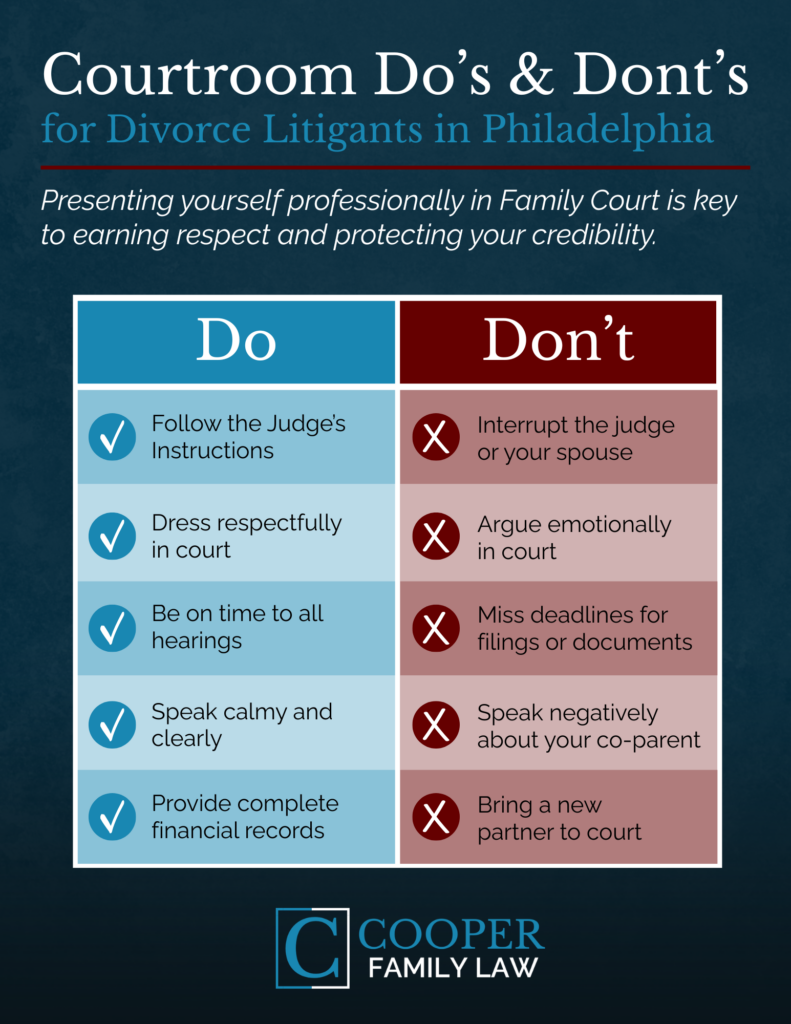
Emotional Control Is Not Optional
Divorce is emotional. Court proceedings are not.
Philadelphia Family Court judges expect litigants to:
- Remain composed during hearings
- Address the court respectfully
- Avoid confrontations or interruptions
This is often harder than it sounds.
But emotional reactions, especially in contentious cases, can overshadow valid legal arguments. Maintaining composure signals credibility, focus, and respect for the process.
The Rules Apply, Even When They Feel Frustrating
Family Court operates under established procedural rules, including the Pennsylvania Rules of Civil Procedure governing divorce actions (Pa.R.C.P. No. 1920).
These rules dictate:
- How filings are made
- When deadlines apply
- How cases move toward resolution
Judges do not adjust these rules based on frustration, fairness arguments, or personal circumstances.
This is an important shift for many people. What feels “unfair” in conversation must still be supported by law and evidence in court.
What Judges Are Really Looking For
Across different cases and circumstances, most judges are evaluating the same core factors:
- Is this person prepared?
- Are their positions supported by evidence?
- Are they acting reasonably within the process?
- Are they focused on resolution or conflict?
These questions often carry as much weight as the legal arguments themselves.
Why Experienced Representation Makes a Difference
Judges do not expect litigants to know every rule or anticipate every issue.
They do expect parties to approach the process responsibly.
An experienced family law attorney helps by:
- Ensuring filings meet procedural requirements
- Presenting issues clearly and efficiently
- Advising on conduct that supports, not undermines, your case
In Philadelphia, where court schedules are tight and expectations are high, avoiding preventable mistakes can make a meaningful difference in how your case progresses.
The Bottom Line
Judges in Philadelphia Family Court expect divorce litigants to be:
- Prepared
- Credible
- Cooperative where appropriate
- Focused on legally relevant issues
Approaching your case with structure and clarity is not just helpful, it is often essential to protecting your interests.
Preparing for Family Court?
If you are facing divorce litigation in Philadelphia, understanding how judges evaluate cases is a critical first step.
At Cooper Family Law, you’ll receive clear, strategic guidance designed to help you present your case effectively, while avoiding the missteps that can create unnecessary setbacks.
Schedule a confidential consultation to discuss your situation and next steps.